AI Content Production Pipeline: n8n plus AI agents

The chain from insight research to a published post eats time and breaks publishing cadence easily. This is how I combined n8n with AI agents to automate most of the pipeline, free up the labour, and keep a human approval step only where it genuinely matters.

Role Designed and built the workflow
Status In production
Tools n8n · AI Agent · Claude · ChatGPT
Core result ×3 output
~6 fewer work hours a week
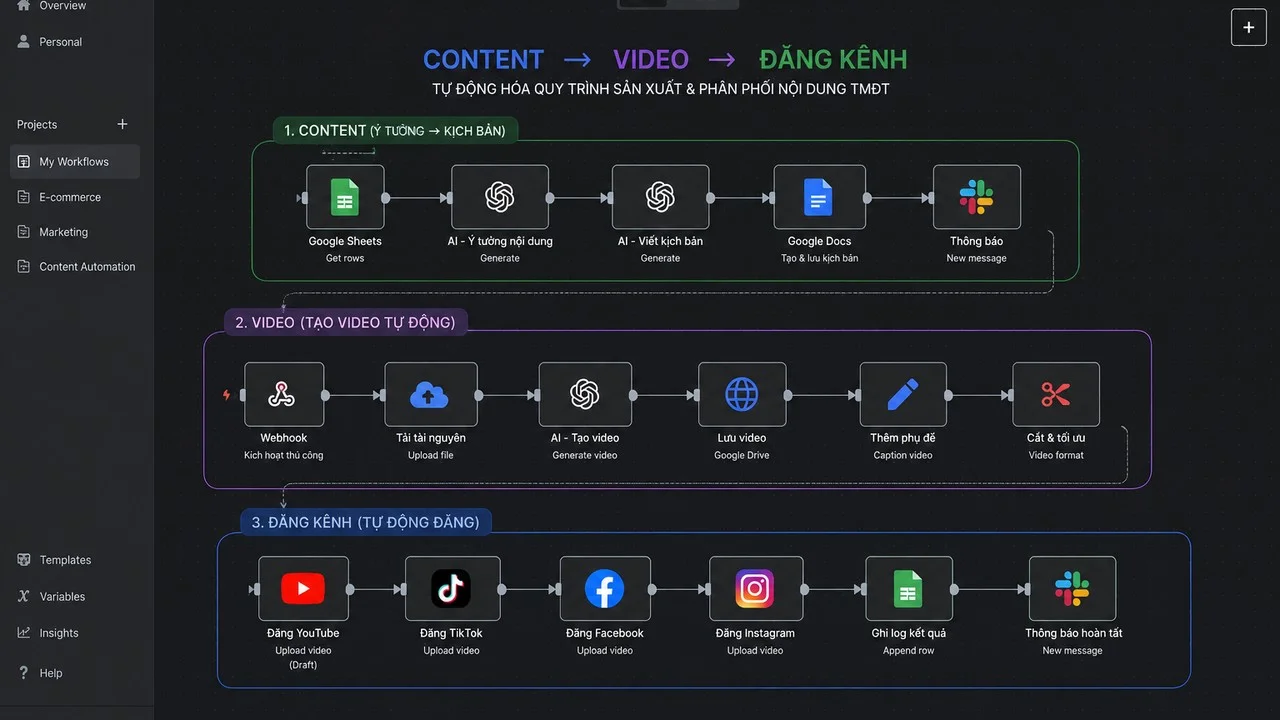
The n8n workflow diagram
01 · Problem

The team was spending its time producing, not thinking

A single post passes through too many stages: insight research, scripting, image generation, video editing and reformatting for each platform. Most of it was still manual, so output speed depended directly on how many human hours were available.

  • The process broke as soon as something urgent came up
  • A lot of effort went into repetitive work, mostly reformatting between platforms
  • Testing several content directions at once was impractical, because each one cost the same to produce
02 · Solution

Pair n8n with AI agents, keep a human at the control point

n8n orchestrates the whole workflow while the AI agents each own a specific stage. The system stops and waits for human approval at the control point before moving on to automated production and distribution.

  • Research & Outline Agent: gathers data, analyses the topic and builds an outline from the input insight
  • Content Agent: develops the script and the platform-specific variants. It works best on mini-vlog scripts and on fashion and beauty review videos fronted by a virtual character
  • Visual & Motion Agent: writes the prompts and drives image generation, image-to-video and motion graphics from the approved script. It is tuned to keep the character's appearance consistent from scene to scene
  • Distribution Agent: publishes automatically to each channel on its own schedule and settings

Human in the loop: for health and supplement content, the manual review step is not optional. It is there to check claims about what a product does, and the risk of a policy breach, before anything is published.

03 · How it runs

From a raw insight to a publishable post

  1. Input: a topic or an insight goes in
  2. Research: the Research & Outline Agent gathers data and builds the outline
  3. Content: the Content Agent writes the script and the per-channel versions
  4. Human review: a person approves the content before the system continues
  5. Production: the Visual & Motion Agent generates the images and builds the video
  6. Distribution: the Distribution Agent publishes across channels on the configured schedule
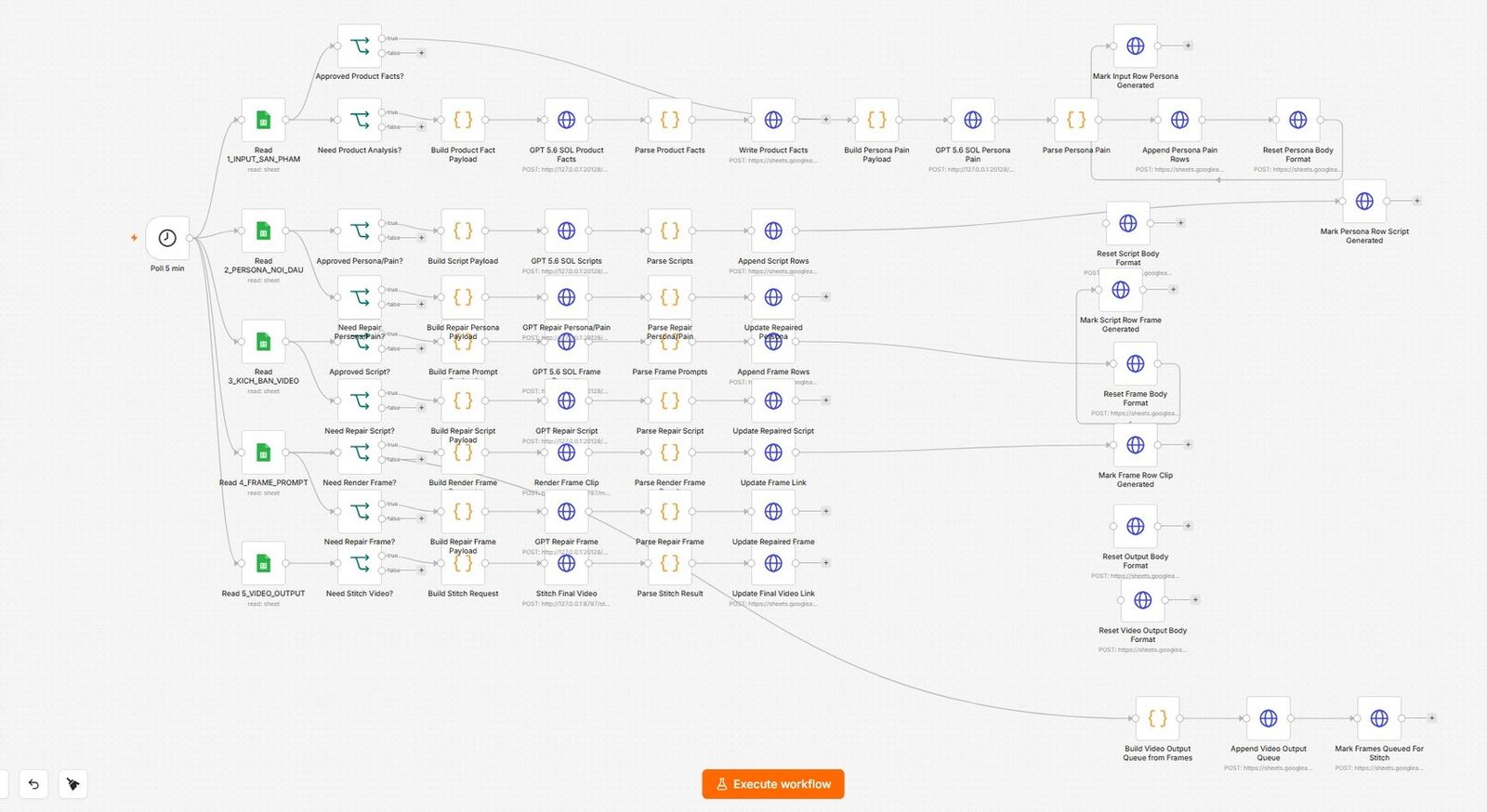
The n8n canvas: branches that read data, check conditions, call the AI, handle errors and write results back to Google Sheets
The real workflow in n8n: each branch is one link in the pipeline, with a check-and-repair branch for when a step comes back with an error. Click the image for full size.
04 · Results

What it bought

MeasureBefore the workflowAfter automation
Time to produce one post~5 hours~40 minutes
Publishing cadence2 posts a week, easily interrupted6 posts a week, consistently
Work hours per week~10 hours for 2 posts~4 hours for 6 posts

The real value is not only the hours saved. Putting AI agents inside n8n widened the range of content and kept the publishing rhythm unbroken, while the team was released from repetitive clicking to concentrate on the quality of the strategy.

Put another way: three times the output for less than half the hours. Held at the old cadence of two posts a week, the same workflow would save around eight hours.

Another project
E-commerce P&L Reporting Dashboard